Search
-
 Still image
Consecration on the Church with Holy Oil
Picart, Bernard, 1673-1733A series of six engravings depicting the process of consecrating the interior of a church with holy oil. The scenes show a bishop anointing and consecrating parts of a church, known as chrism, including crosses on the walls, the trappings of the altar, and the altar itself. -
 Still image
Consecration of the Altar
Picart, Bernard, 1673-1733A series of six engravings depicting the process of blessing an altar. The scenes include (top left), a bishop following behind a subdeacon spreading ash on the ground writing the Latin and Greek alphabets in a cross shape (top left), a bishop anointing the altar (middle left) and the floor (middle right) with holy water, a procession bringng relics into the church (bottom left), and a bishop placing the relics inside the altar (bottom right). -
 Still image
Blessing a New Church
Picart, Bernard, 1673-1733A series of six engravings depicting the process for blessing a new church as it is built. The scenes include a bishop blessing the first stone (top left) and the earth on which the church will be built (top right), a bishop then placing the first stone (middle left) and blessing the church foundation (middle right), a bishop sprinkling holy water on the completed church (bottom left) and making the sign of the cross at the door (bottom right). -
 Still image
Ornamental Tailpiece: Ritual Objects
Picart, Bernard, 1673-1733An engraved ornamental tailpiece appearing at the end of the introductory section. The engraving depicts a platform with the inscription "Finis" above which hangs a bell and drapery. Holding the drapery and bell up is a decorative boarder featuring a pair of cherubs, a censer, a stole, an open book (likely a Bible), and other Catholic ritual items. -
 Still image
Il vero ritratto, la vita, morte, fatti, et miracoli di Santo Carolo Borromeo
Jode, Pieter de, 1606-approximately 1674This large-format broadside was probably issued to commemorate and popularize the canonization of Charles Borromeo (1538-1584) in November of 1610. Borromeo was a crucial interlocutor during the final sessions of the Council of Trent and also undertook many reforming practices while serving as the Archbishop of Milan. Although the engraving was printed in Antwerp, the text including the detailed captions demonstrate that it was intended for an Italian audience. -
 Still image
Histoire des Conclaves Frontispiece
An engraved frontispiece of Histoire des conclaves depuis Clement V. jusqu'à present, augmentée, depuis la première édition, de plusieurs mémoires concernans le pape & les cardinaux d'aujourdhui, & les principales familles de Rome : où l'on apprend quantité de particularitez de cette cour. Avec un discours qui explique, suivant le taille douce, toutes les cérémonies qui s'observent depuis la mort du pape, jusqu'après l'élection de son successeur. -
 Still image
Obeliscus Pamphilius
An engraving depicting detailed representations of the four sides of the Obelisk of Domitian, which had been moved by Pope Innocent X from the Via Appia to his family home, the Palazzo Pamphilj. Between the four sides, there is a small representation of the obelisk with a decorative ribbon proclaiming it the "Obelisus Pamphilius" (bottom), a cherub holding a pair of medallions with a portrait of Innocent X (left) and the obelisk (right) (middle), and an angel lying on a cloud supporting Innocent X's coat of arms. -
 Still image
Scala Santa di Sisto et Cavalli del Quirinale
A pair of engravings depicting the Scala Sancta at St. John Lateran and statues of the Dioscuri with horses which were moved to the Piazza del Quirinale, both of which were a part of Pope Sixtus V's urban reform program. -
 Still image
Cupola di San Pietro fatta da Sesto et Libraria Vaticana
A pair of engravings depicting the dome atop St. Peter's Basilica and the Vatican Library, both of which were parts of Pope Sixtus V's urban reform program. -
 Still image
Aguglia del Popolo, Aguglia di San. Pietro, Santi Apostoli, et C. Traj[an]
A pair of engravings depicting four obelisks (Vatican Obelisk, Lateran Obelisk, Flaminio Obelisk, and the Esquiline Obelisk), the Santi Apostoli, and Trajan's Column. All of these were part of Pope Sixtus V's urban reform program. -
 Still image
Del Ponte, & Arco Trionfale
An engraving depicting a Roman triumphal procession passing through a triumphal gate and accross the triumphal bridge (Pons Neronianus/Vaticanus) along the triumphal way (Via Triumphale) across the Tiber River. Above the scene, an angel flies, blowing on a trumpet that is draped with a flag bearing a crest with "S.P.Q.R." on it. The accompanying text discusses sources that claim St. Peter was buried near the Via Triumphale. -
 Still image
Historiated title page border of Descrizione di Roma moderna formata nvovamente
An engraved border to Descrizione di Roma moderna formata nvovamente. The engraving depicts a pair of figures, one holding a cross and chalice and the other holding an anchor flanking a crest with three bees (the Barberini family) crowned by a galero (bottom), a pair of cherubs with shields (one with the papal keys and the other with S.P.Q.R. -
 Still image
Lateran Palace and the Lateran Obelisk
An engraving depicting the Lateran Palace (left) with the Lateran Obelisk (foreground), with the Archbasilica of Saint John Lateran (right) visible with the Baptistry on its right. -
 Still image
St. Peter's Basilica
An engraving depicting St. Peter's Basilica and surrounding buildings and monuments, including the Papal Palace, the Sistine Chapel, the Vatican Obelisk, the Sacristy, and St. Peter's Square. -
 Still image
Coffin of Pope Pius V
Dorigny, Nicolas, 1658-1746An engraving depicting the coffin of Pope Pius V. The side of the coffin features a relief of the Pope in repose and has a decorative lid featuring a crest reading, "CORPUS B. PII. V. PONT. MAX. EX ORD. FF. PRAED." surrounded by cherub heads, roses, and lilies. -
 Still image
The Pope with Saints and Biblical Figures
An engraving depicting a scene of the pope (possibly Pope Gregory XIII) enthroned and surrounded by bishops and cardinals, a dove perched on the back of his throne. Surrounding this scene is a series of portraits of saints and biblical figures, including (from top left down, around, and up): Saint Augustine, Saint John, Saint Matthew, Saint Luke, Saint Mark, Saint Paul, Pope Gregory I (Saint), Saint Ambrose, Jeremiah, Isaiah, David, Job, Moses, and Saint Jerome. -
 Still image
The Council of Trent
An engraving depicting a session of the Council of Trent with the label, "The Representation of the Fathers assembled in the Council of Trent: begun about the end of the year 1545. Concluded towards the end of 1563, under the Pontificate of Paul III, Julius III, Marcel II, Paul IV, and Pius IV. There were XXV Sessions, in which were present VII Cardinals, V whereof were the Popes LEgates, XVI Ambassadours from Kings, Princes & Republicks, CCL Patriarchs, Archbishops, Bishops, Abbots and Generals of Orders, All Divines and Doctours of the Civil and Canon Law." -
 Still image
Saint Louis and the Crown of Thorns
Chauveau, François, 1613-1676An engraving depicting a scene from the eighteenth book of the epic poem, Saint Louys, in which God destroys a false Crown of Thorns which would have caused plague and bestows the true Crown of Thorns on Saint Louis. -
 Still image
Zahide's Vision of Mary
Chauveau, François, 1613-1676An engraving depicting a scene from the seventeenth book of the epic poem, Saint Louys, in which a recovered Zahide sees a vision of the Virgin Mary surounded by angels and holding a cross, and is converted. -
 Still image
Archambaut de Bourbon Defeates Mirème
Chauveau, François, 1613-1676An engraving depicting a scene from the sixteenth book of the epic poem, Saint Louys, in which Archambaut de Bourbon battles and defeats the sorcerer, Mirème, who has created demonic illusions and traps to keep the cruasders from accessing the Matariya Fountain and curing Saint Louis of his poisoned arrow wound. -
 Still image
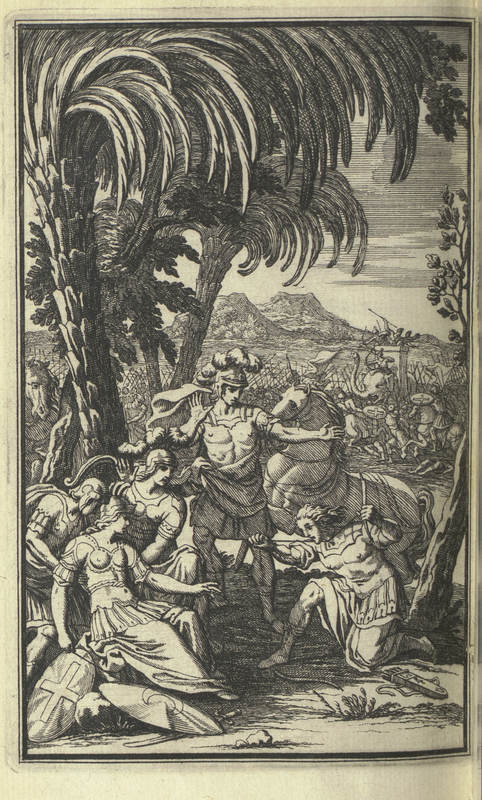
The Death of Alfasel
Chauveau, François, 1613-1676An engraving depicting a scene from the fifteenth book of the epic poem, Saint Louys, in which Alfasel (bottom right), who had accidentally wounded Zahide (bottom left) with a poisoned arrow while aiming for Lisamante, commits suicide. Meanwhile, Zahide is taken prisioner while in the background, the battle between the crusaders and the Saracens continues.

Page 169 of 254
