• A group photo of participants in the Revival Forum 2023: Changed Understanding of Revival held in Seoul in the summer of 2023. The forum featured notable attendees and speakers, including: Dr. Helen Jin Kim, Bishop Yun-soo Chung, Rev. Dr. Hong-ki Kim, and Rev. Dr. Young-seok Seo.
    Still image

    Participants at the Revival Forum 2023: Changed Understanding of Revival

    Kim, Sangeon
    A group photo of participants in the Revival Forum 2023: Changed Understanding of Revival held in Seoul in the summer of 2023. The forum featured notable attendees and speakers, including: Dr. Helen Jin Kim, Bishop Yun-soo Chung, Rev. Dr. Hong-ki Kim, and Rev. Dr. Young-seok Seo.
  • From Wikimedia: 정동교회 정문방향 사진
    Still image

    서울특별시

    Black207
    From Wikimedia: 정동교회 정문방향 사진
  • Passport application no. 265091 for Joseph Lumpkin Gerdine, issued in 1923.
    Text

    Passport application for Joseph Lumpkin Gerdine

    United States. Immigration and Naturalization Service
    Passport application no. 265091 for Joseph Lumpkin Gerdine, issued in 1923.
  • Passport application no. 44440 for Joseph Lumpkin Gerdine and Eleanor D, issued in 1921.
    Text

    Passport application for Joseph Lumpkin Gerdine and Eleanor D

    United States. Immigration and Naturalization Service
    Passport application no. 44440 for Joseph Lumpkin Gerdine and Eleanor D, issued in 1921.
  • Passport application no. 16881 for Joseph Lumpkin Gerdine and Eleanor Daisy Dye Gerdine, issued in 1918.
    Text

    Passport application for Joseph Lumpkin Gerdine and Eleanor Daisy Dye Gerdine

    United States. Immigration and Naturalization Service
    Passport application no. 16881 for Joseph Lumpkin Gerdine and Eleanor Daisy Dye Gerdine, issued in 1918.
  • Passport application no. 44349 for Joseph L Gerdine and E D Gerdine, issued in 1911.
    Text

    Passport application for Joseph L Gerdine and E D Gerdine

    United States. Immigration and Naturalization Service
    Passport application no. 44349 for Joseph L Gerdine and E D Gerdine, issued in 1911.
  • Passport application no. 63634 for Joseph Lumpkin Gerdine, issued in 1908.
    Text

    Passport application for Joseph Lumpkin Gerdine

    United States. Immigration and Naturalization Service
    Passport application no. 63634 for Joseph Lumpkin Gerdine, issued in 1908.
  • A portrait of Kyeong Ah Min taken during an interview with Sangeon Kim.
    Still image

    민경아

    Kim, Sangeon
    A portrait of Kyeong Ah Min taken during an interview with Sangeon Kim.
  • A map of the world with latitude and longitude markers as it was known during the Ptolemaic period, including mountain ranges and rivers and spanning from Europe, to central Africa, and over to India. Personifications of the winds are depicted within the clouds surrounding the map.
    Still image

    Ptolemaisch general [catel] - [...] greiffend die halbe fugel der weldt.

    A map of the world with latitude and longitude markers as it was known during the Ptolemaic period, including mountain ranges and rivers and spanning from Europe, to central Africa, and over to India. Personifications of the winds are depicted within the clouds surrounding the map.
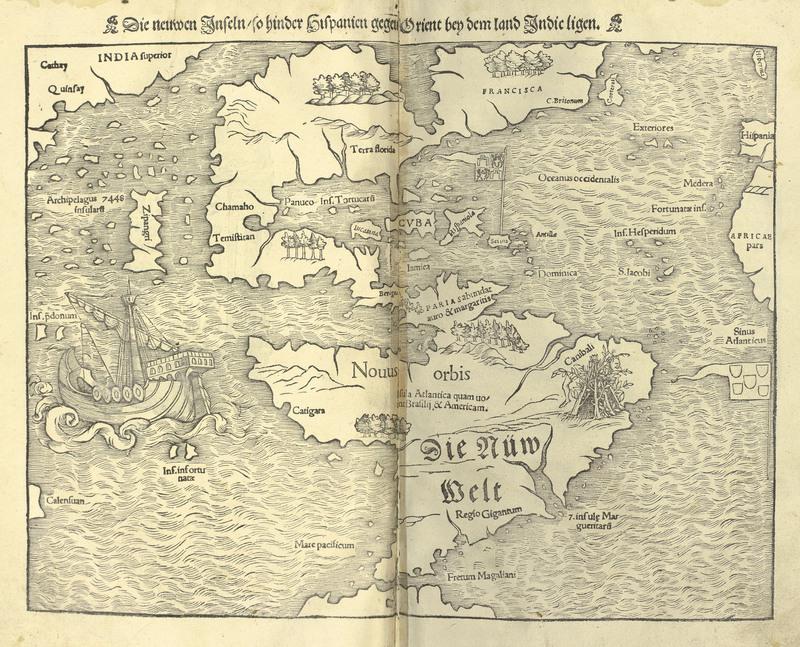
  • A map of the western hemisphere, identified as the New World, and the western coast of Asia. A spanish style galleon ship is depicted sailing in the Pacific ocean, and a rough shelter built of sticks featureing a dismembered leg is depicted in the general region of Brazil with the label, "Canibali".
    Still image

    Die neuwen Inseln - so hinder Hispanien gegen Orient bey dem land Indic ligen.

    A map of the western hemisphere, identified as the New World, and the western coast of Asia. A spanish style galleon ship is depicted sailing in the Pacific ocean, and a rough shelter built of sticks featureing a dismembered leg is depicted in the general region of Brazil with the label, "Canibali".
  • A map of the world including latitude and longitude markers. Personifications of the winds are depicted withing croulds surrounding the map and various monstrous creatures are depicted within the oceans.
    Still image

    Das erst general - inhaltend die beschzeibung [und] den [circtel] des gantzen erdtreichs und m[o]rcs.

    A map of the world including latitude and longitude markers. Personifications of the winds are depicted withing croulds surrounding the map and various monstrous creatures are depicted within the oceans.
  • The story of how this obelisk came to be in the piazza of the Lateran spans three thousand years. It was first quarried by Thutmose III around 1450 BC and stood at the Temple of Amun at Karnak. When the emperor Augustus (27 BC-14 AD) had the first obelisks brought from Egypt to Rome in 10 BC, he had considered this one, but was deterred by the fact that it was the largest of all obelisks (being over 32 meters tall and weighing 455 tons). The obelisk remained at Karnak until Constantine the Great (306-337), intending to send it to Constantinople, had it transported down the Nile to Alexandria. It went no further, however, until his son Constantius II (337-361) brought it to Rome in 357 and had it erected on the central barrier of the Circus Maximus. There it joined one of the obelisks brought earlier by Augustus. In Egypt obelisks were always dedicated by the pharaoh to the sun god. They retained these same associations with supreme royal authority and the cult of the sun when they were relocated, but now the supreme authority had passed to the emperors of Rome. Sometime after the sixth century both obelisks fell, broke into three parts, and were buried under the mud in the frequently flooded Circus. By the time of the Renaissance, antiquarians knew that the two obelisks should still be at the site from their study of classical sources. Pope Sixtus V (1585-1590), hearing about this just after he had moved the Vatican obelisk to the front of St. Peter's, ordered the obelisks to be excavated. It took nine months and 300 men to uncover and move the huge stone of the obelisk of Constantius to the piazza where it was reassembled and raised. In an elaborate ceremony in 1588 it was exorcised of pagan demons, consecrated, and rededicated to "the most invincible Cross." Topped by the cross and the pope's coat-of-arms, the obelisk's inherent power and authority then passed to the Christian church. Piranesi has made the soaring emblem the sole focus of this view, depicting its hieroglyphs in detail, if not with complete accuracy.
    Still image

    Egyptian Obelisk Erected by Sixtus V in the Piazza of S. Giovanni in Laterano

    Piranesi, Giovanni Battista, 1720-1778
    The story of how this obelisk came to be in the piazza of the Lateran spans three thousand years. It was first quarried by Thutmose III around 1450 BC and stood at the Temple of Amun at Karnak. When the emperor Augustus (27 BC-14 AD) had the first obelisks brought from Egypt to Rome in 10 BC, he had considered this one, but was deterred by the fact that it was the largest of all obelisks (being over 32 meters tall and weighing 455 tons).
  • This view of the Belvedere Gardens and Courtyard at the Vatican is particularly important since it shows the courtyard as it was originally designed by Donato Bramante in 1505. Bramante's design offered an unobstructed prospect from the papal apartments (at left) through the length of the courtyard to the exedra, the semi-circular structure at the right of the image. This perspectival view was later blocked by the construction of a library for Pope Sixtus V in 1587-89.
    Still image

    Belvedere Gardens

    Brambilla, Ambrogio, active approximately 1579-1599
    This view of the Belvedere Gardens and Courtyard at the Vatican is particularly important since it shows the courtyard as it was originally designed by Donato Bramante in 1505. Bramante's design offered an unobstructed prospect from the papal apartments (at left) through the length of the courtyard to the exedra, the semi-circular structure at the right of the image. This perspectival view was later blocked by the construction of a library for Pope Sixtus V in 1587-89.
  • The lower third of Falda's plan shows the Belvedere Court designed in 1505 by Donato Bramante for Pope Julius II (1503-1513) to link the palace with a fifteenth-century villa on the grounds. The small courtyard (no. 9 on the plan) at the lower right housed the incomparable collection of ancient sculpture begun by Pope Julius which included such works as the Laocoon. The view of the garden seems to be from the vantage point of the gallery which frames the court, looking straight across parterres of herbs to the Casino of Pius IV built by the antiquarian architect Pirro Ligorio in the 1560s. The casino was a place of retreat for the pope where he and his companions could contemplate the numerous reliefs and inscriptions that encrusted the walls facing onto the inner courtyard. At the lower left is the Fountain of the Mirrors with its giochi d'acqua or water games. Tricks with fountains that would suddenly drench unsuspecting visitors were a very popular feature in Italian Renaissance gardens.
    Still image

    Plan and Elevation of the Belvedere Garden of the Vatican Palace

    Falda, Giovanni Battista, approximately 1640-1678
    The lower third of Falda's plan shows the Belvedere Court designed in 1505 by Donato Bramante for Pope Julius II (1503-1513) to link the palace with a fifteenth-century villa on the grounds. The small courtyard (no. 9 on the plan) at the lower right housed the incomparable collection of ancient sculpture begun by Pope Julius which included such works as the Laocoon.
  • Summary: A map of Rome including illustrations of historic buildings and churches of the city; and also includes names and insignia of the 14 regions of the city of Rome.
    Still image

    Recentis Romae ichnographia et hypsographia sive planta et facies ad magnificentiam qva svb Alexandro VII P.M. vrbs ipsa directa excvlta et decorata est

    Falda, Giovanni Battista, approximately 1640-1678
    Summary: A map of Rome including illustrations of historic buildings and churches of the city; and also includes names and insignia of the 14 regions of the city of Rome.
  • The print depicts the cavalcade accompanying Pope Clement XI from the Vatican Basilica to the Basilica of Saint John Lateran in Rome on April 10, 1701
    Still image

    Nuouo disegno dell'ordine tenuto nella solenne cavalcata dal palazzo vaticano alla basilica lateranense per il possesso preso da Nostro Signore papa Clemente XI. il di X. aprile M.DCCI

    The print depicts the cavalcade accompanying Pope Clement XI from the Vatican Basilica to the Basilica of Saint John Lateran in Rome on April 10, 1701
  • Dlan, Médellus, Silacier : un peuple en trois personnes, le "petit peuple" antillais de qui la "gentillesse", la malice et la philosophie désabusée pourraient prêter ailleurs à d'aimables tableaux folkloriques.Mais on ne s'y trompera pas. La trame de l'histoire n'est rien de moins que la difficile recherche d'une vérité : à propos d'un tueur à gages (antillais) et pour venger peut-être sa victime (antillaise). Et les péripéties apparemment les plus plaisantes de cette histoire - par exemple les mises en scène électorales - s'inscrivent ainsi dans une Histoire qui déborde la chronologie et qui fait, au même titre que la "vision de ceux qui sans fin tombent et se relèvent fusillés", de la dérision une violence constante.Il s'agit bien d'une "malemort", de ce que l'auteur appelle "une colonisation réussie", celle du peuple antillais économiquement et culturellement déraciné sur son propre sol ; malemort que le langage d'un poète - musique, danse, liane -, recréant de l'intérieur un parler lui aussi "colonisé", dénonce et combat encore.
    Text

    Malemort : roman

    Glissant, Édouard, 1928-2011
    Dlan, Médellus, Silacier : un peuple en trois personnes, le "petit peuple" antillais de qui la "gentillesse", la malice et la philosophie désabusée pourraient prêter ailleurs à d'aimables tableaux folkloriques.Mais on ne s'y trompera pas. La trame de l'histoire n'est rien de moins que la difficile recherche d'une vérité : à propos d'un tueur à gages (antillais) et pour venger peut-être sa victime (antillaise).
  • Print shows a Haitian military officer, holding a printed copy of the Constitution of 1801, standing opposite a bishop appealing to an image of God or Moses in the heavens, with other Haitians and soldiers gathered around. Includes remarque: Liberté, Egalite, République d'Haïty, showing two cannons, a liberty cap atop a pole, banners, and olive branches.
    Still image

    Le 1er. Juillet 1801, Toussaint-L'Ouverture, chargés des pouvoirs du peuple d'Haïty et auspices du Tout-puissante, proclame la Gouverneur général, assisté des mandataires légalement convoqués, en présence et sous les Constitution de la république d'Haïty / lith. de Villain, r. de Sèvres No. 11

    Print shows a Haitian military officer, holding a printed copy of the Constitution of 1801, standing opposite a bishop appealing to an image of God or Moses in the heavens, with other Haitians and soldiers gathered around. Includes remarque: Liberté, Egalite, République d'Haïty, showing two cannons, a liberty cap atop a pole, banners, and olive branches.
  • Nine inch nails driven through walls from inside the building compose a uniform grid, protecting unknown contents within.
    Still image

    Sealed building in the southwest corner of the Saint Paul Spiritual Holy Temple; photo by James Perry Walker, ca. 1995

    Walker, James Perry
    Nine inch nails driven through walls from inside the building compose a uniform grid, protecting unknown contents within.
  • One of three crosses making different zones across a two-acre field at the Saint Paul Spiritual Holy Temple in Memphis, Tennessee.
    Still image

    Omni-directional cross #1; Courtesy of Judith McWillie, painter and author, Professor Emerita of the Lamar Dodd School of Art, University of Georgia.

    McWillie, Judith
    One of three crosses making different zones across a two-acre field at the Saint Paul Spiritual Holy Temple in Memphis, Tennessee.
  • Through bold color and aggressive imagery, predatory animal references, horns, and strange tubular eyes this mask is a visually intimidating presence that harnesses the power of spirits from the wilderness as instruments of proprietary control in the realm of the town or village. Their visual affect was only heightened during performance. This Wé mask presents a bewildering accumulation of animal references: a fringe of aluminum-silver pseudo-leopard teeth, wild boar tusks, and pointed ears. With its bold color and bullet casings, this prototypical nature spirit mask is wild and menacing, making it a powerful judge during legal disputes and a great motivator of men preparing for battle.
    Artifact

    Mask

    White, Bruce M.
    Through bold color and aggressive imagery, predatory animal references, horns, and strange tubular eyes this mask is a visually intimidating presence that harnesses the power of spirits from the wilderness as instruments of proprietary control in the realm of the town or village. Their visual affect was only heightened during performance. This Wé mask presents a bewildering accumulation of animal references: a fringe of aluminum-silver pseudo-leopard teeth, wild boar tusks, and pointed ears.
  • This mask, called Sowo (pl. Sowei) or Bondo, is a type commissioned and worn by female members of the Gola, Temne, and Mende Sande societies in Sierra Leone and Liberia. The Sande society is responsible for the instruction of young girls into adulthood. This process occurs in the forest under the guidance of senior Sande members and Sowo or Bondo nature spirits. Once they have learned basic female values and trained for marriage, domestic life, and religious, economic, and political pursuits, the girls are integrated back into the village as women. On this festive occasion they are accompanied by Sowei masqueraders. Although owned by women, Sande masks are carved by male artists who work in dialogue with their personal neme spirit, as well as the individual Sowo spirit that will inhabit the mask during masquerade performances. While carving is not always a professionalized specialty, artists are considered exceptional people and are called yun go gwa, "a dreamer". A dreamer's neme spirit bestows gifts of talent and greatness, though often at a price. An artist demonstrates his relationship with the supernatural by making visible in his art that which he has dreamed. When a Sande society member commissions a mask, she reveals to the artist the name of the individual Sande spirit to inhabit it. The artist then secludes himself in the forest, the realm of Sande spirits, to visualize through dreams the personality of the spirit that will inhabit the mask. The mask must be refined and aesthetically pleasing, or the spirit will not enter it. Small facial features, rings round the neck, a broad forehead, beautiful hairstyles, and a dark shiny surface are the aesthetic ideals favored by Sande spirits. Each mask also makes visible the halei, (powerful medicine of Sowo spirits) through carved horns and amulets. Although each mask features female imagery, such as the incised marks below the eyes refered to as "tears", the spirit emodied in the mask is a male one, coming to claim the women. Once the mask is carved it is consecrated by its owner with applications of medicinal substances (halei) and the addition of real amulets. The mask is then ready to manifest a spirit during masquerade performances when it is worn by its owner.
    Artifact

    Helmet Mask (Sowei)

    White, Bruce M.
    This mask, called Sowo (pl. Sowei) or Bondo, is a type commissioned and worn by female members of the Gola, Temne, and Mende Sande societies in Sierra Leone and Liberia. The Sande society is responsible for the instruction of young girls into adulthood. This process occurs in the forest under the guidance of senior Sande members and Sowo or Bondo nature spirits. Once they have learned basic female values and trained for marriage, domestic life, and religious, economic, and political pursuits, the girls are integrated back into the village as women.
  • Masks from the Cameroon Grassfields were owned by either the men's regulatory society (Kwifoyn) that shared power with the king (Fon), or by lineage groups authorized by the Kwifoyn to perform. Although all masked dancers in the Grassfields are male, they may represent either male or female characters. This mask represents Ngoin, the royal wife and a symbol of womanhood. The mask can be identified by the royal headdress that has an almond or oval-shaped protruberance at the top and a wavy or zigzag hairline. Ngoin dances with short, restrained steps to mark her royal presence.
    Artifact

    Female Helmet Crest Mask, Ngoin

    White, Bruce M.
    Masks from the Cameroon Grassfields were owned by either the men's regulatory society (Kwifoyn) that shared power with the king (Fon), or by lineage groups authorized by the Kwifoyn to perform. Although all masked dancers in the Grassfields are male, they may represent either male or female characters. This mask represents Ngoin, the royal wife and a symbol of womanhood. The mask can be identified by the royal headdress that has an almond or oval-shaped protruberance at the top and a wavy or zigzag hairline. Ngoin dances with short, restrained steps to mark her royal presence.
  • The Dogon migrated to present-day Mali beginning in the fifteenth century, settling along the Bandiagara escarpment. The harsh, remote terrain of central Mali protected the Dogon and shaped their culture. The Kanaga mask honors the dead and connects them to the living, in much the same way as the long cliff on which they live connects the earth and sky, and the vertical strip of the mask connects the two horizontal bands. Young men wear the Kanaga mask during the Dama ceremony, a funeral festival that occurs every twelve years in which the masks lead those who died during the cycle to the afterlife. The masks are painted with white, black, and often washer's blue, a chalky material traditionally used to whiten clothes in the laundry. A brightly colored raffia mane surrounds the face and complements the raffia bands along the arms and feet of the dancer. The dancer also wears a kilt and suspenders. The masquerader secures the mask by biting down on a bit, though there is netting in the back to keep it upright. Though the wood is not heavy, his dance includes whipping his body around and scraping the tip of the mask to the earth, making it a dynamic and audible procession.
    Artifact

    Kanaga Mask

    White, Bruce M.
    The Dogon migrated to present-day Mali beginning in the fifteenth century, settling along the Bandiagara escarpment. The harsh, remote terrain of central Mali protected the Dogon and shaped their culture. The Kanaga mask honors the dead and connects them to the living, in much the same way as the long cliff on which they live connects the earth and sky, and the vertical strip of the mask connects the two horizontal bands.
  • A headdress carved from wood and decorated with pigment.
    Artifact

    Headdress for Egungun Masquerade Costume

    Adugbologe School
    A headdress carved from wood and decorated with pigment.
  • Third album of gospel music by Mother Willie Mae Ford Smith.
    Audio

    I'm Bound for Canaan Land

    Smith, Willie Mae Ford
    Third album of gospel music by Mother Willie Mae Ford Smith.
  • Close your eyes--make the white gaze disappear. What is it like to be black and joyful, without submitting to the white gaze? This question, and its answer, is at the core of Black Imagination, a dynamic collection collection curated by artist and poet Natasha Marin. Born from a series of exhibitions and fueled by the power of social media (#blackimagination), the collection includes work from a range of voices who offer up powerful individual visions of happiness and safety, rituals and healing. Black Imagination presents an opportunity to understand the joy of blackness without the lens of whiteness.
    Text

    Black Imagination: Black Voices on Black Futures

    Marin, Natasha
    Close your eyes--make the white gaze disappear. What is it like to be black and joyful, without submitting to the white gaze? This question, and its answer, is at the core of Black Imagination, a dynamic collection collection curated by artist and poet Natasha Marin. Born from a series of exhibitions and fueled by the power of social media (#blackimagination), the collection includes work from a range of voices who offer up powerful individual visions of happiness and safety, rituals and healing.
  • The first track on the 1959 album Kind of Blue by American trumpeter Miles Davis.
    Audio

    So What?

    Davis, Miles
    The first track on the 1959 album Kind of Blue by American trumpeter Miles Davis.
  • Miles Davis originally began recording this album in 1985. It marked a radical departure from his usual sound with the inclusion of funk and soul grooves. However, it was shelved and left unheard and untouched for 30 years. Now it has been completed.
    Audio

    Rubberband

    Davis, Miles
    Miles Davis originally began recording this album in 1985. It marked a radical departure from his usual sound with the inclusion of funk and soul grooves. However, it was shelved and left unheard and untouched for 30 years. Now it has been completed.
  • In this 1939 novel based on the familiar story of the Exodus, Zora Neale Hurston blends the Moses of the Old Testament with the Moses of black folklore and song to create a compelling allegory of power, redemption, and faith. Narrated in a mixture of biblical rhetoric, black dialect, and colloquial English, Hurston traces Moses's life from the day he is launched into the Nile river in a reed basket, to his development as a great magician, to his transformation into the heroic rebel leader, the Great Emancipator. From his dramatic confrontations with Pharaoh to his fragile negotiations with the wary Hebrews, this very human story is told with great humor, passion, and psychological insight—the hallmarks of Hurston as a writer and champion of black culture.
    Text

    Moses: man of the mountain

    Hurston, Zora Neale
    In this 1939 novel based on the familiar story of the Exodus, Zora Neale Hurston blends the Moses of the Old Testament with the Moses of black folklore and song to create a compelling allegory of power, redemption, and faith. Narrated in a mixture of biblical rhetoric, black dialect, and colloquial English, Hurston traces Moses's life from the day he is launched into the Nile river in a reed basket, to his development as a great magician, to his transformation into the heroic rebel leader, the Great Emancipator.
  • In the history of recorded blues and spirituals, there is no greater singer and songwriter than Blind Willie Johnson. With a vocal delivery ranging from raw rage to tenderness wedded to his talking guitar, Blind Willie's recordings are as powerful today as when he made them, from 1927 to 1930. Listen to monuments "Motherless Children Have a Hard Time," "I Just Can't Keep from Crying," "It's Nobody's Fault but Mine," and the otherworldly "Dark Was the Night, Cold Was the Ground," and try to find equally visceral conviction any other place or time. His "If I Had My Way I'd Tear The Building Down" which got him arrested when Blind Willie unknowingly sang it in front of a U.S. government building in Dallas, became a '60s icon. Years later, he caught pneumonia, but when treatment was sought, he was told the hospital did not treat blind people, so he returned home and died. --Alan Greenberg
    Audio

    The complete Blind Willie Johnson

    Johnson, Blind Willie
    In the history of recorded blues and spirituals, there is no greater singer and songwriter than Blind Willie Johnson. With a vocal delivery ranging from raw rage to tenderness wedded to his talking guitar, Blind Willie's recordings are as powerful today as when he made them, from 1927 to 1930.
  • On this 16-track collection we get to hear some legendary artists perform the great compositions from "the father of gospel music." Includes Take My Hand, Precious Lord Marion Williams; When the Gates Swing Open Dixie Hummingbirds; (There'll Be) Peace in the Valley R. H. Harris; Highway to Heaven Alex Bradford (with Dorsey on piano), and others.
    Audio

    Precious Lord: Recordings of the Great Gospel Songs of Thomas A. Dorsey

    Dorsey, Thomas A.
    On this 16-track collection we get to hear some legendary artists perform the great compositions from "the father of gospel music." Includes Take My Hand, Precious Lord Marion Williams; When the Gates Swing Open Dixie Hummingbirds; (There'll Be) Peace in the Valley R. H. Harris; Highway to Heaven Alex Bradford (with Dorsey on piano), and others.
  • An annual guidebook for African-American roadtrippers.
    Text

    The Negro motorist green book

    Green, Victor H.
    An annual guidebook for African-American roadtrippers.
  • Shifting in time between the years preceding the Civil War and the years immediately following it. "Beloved" is the story of how an escaped slave tries to overcome the tragic death of her daughter. Morrison's lyrical narrative weaves together the supernatural and the tangible, and the result is a dazzling achievement and a spellbinding reading experience.
    Text

    Beloved

    Morrison, Toni
    Shifting in time between the years preceding the Civil War and the years immediately following it. "Beloved" is the story of how an escaped slave tries to overcome the tragic death of her daughter. Morrison's lyrical narrative weaves together the supernatural and the tangible, and the result is a dazzling achievement and a spellbinding reading experience.
  • Édouard Glissant, long recognized in the French and francophone world as one of the greatest writers and thinkers of our times, is increasingly attracting attention from English-speaking readers. Born in Martinique in 1928, Glissant earned a doctorate from the Sorbonne. When he returned to his native land in the mid-sixties, his writing began to focus on the idea of a "relational poetics," which laid the groundwork for the "créolité" movement, fueled by the understanding that Caribbean culture and identity are the positive products of a complex and multiple set of local historical circumstances. Some of the metaphors of local identity Glissant favored--the hinterland (or lack of it), the maroon (or runaway slave), the creole language--proved lasting and influential. In Poetics of Relation, Glissant turns the concrete particulars of Caribbean reality into a complex, energetic vision of a world in transformation. He sees the Antilles as enduring suffering imposed by history, yet as a place whose unique interactions will one day produce an emerging global consensus. Arguing that the writer alone can tap the unconscious of a people and apprehend its multiform culture to provide forms of memory capable of transcending "nonhistory," Glissant defines his "poetics of relation"--both aesthetic and political--as a transformative mode of history, capable of enunciating and making concrete a French-Caribbean reality with a self-defined past and future. Glissant's notions of identity as constructed in relation and not in isolation are germane not only to discussions of Caribbean creolization but also to our understanding of U.S. multiculturalism. In Glissant's view, we come to see that relation in all its senses--telling, listening, connecting, and the parallel consciousness of self and surroundings--is the key to transforming mentalities and reshaping societies. This translation of Glissant's work preserves the resonating quality of his prose and makes the richness and ambiguities of his voice accessible to readers in English.
    Text

    Poetics of relation

    Glissant, Édouard, 1928-2011
    Édouard Glissant, long recognized in the French and francophone world as one of the greatest writers and thinkers of our times, is increasingly attracting attention from English-speaking readers. Born in Martinique in 1928, Glissant earned a doctorate from the Sorbonne.
  • Frantz Fanon may be most known for his more obviously political writings, but in the first instance, he was a clinician, a black Caribbean psychiatrist who had the improbable task of treating disturbed and traumatized North African patients during the wars of decolonization. Investigating and foregrounding the clinical system that Fanon devised in an attempt to intervene against negrophobia and anti-blackness, this book rereads his clinical and political work together, arguing that the two are mutually imbricated. For the first time, Fanon's therapeutic innovations are considered along with his more overtly political and cultural writings to ask how the crises of war affected his practice, informed his politics, and shaped his subsequent ideas. As David Marriott suggests, this combination of the clinical and political involves a psychopolitics that is, by definition, complex, difficult, and perpetually challenging. He details this psychopolitics from two points of view, focusing first on Fanon's sociotherapy, its diagnostic methods and concepts, and second, on Fanon's cultural theory more generally. In our present climate of fear and terror over black presence and the violence to which it gives rise, Whither Fanon? reminds us of Fanon's scandalous actuality and of the continued urgency of his message.
    Text

    Whither Fanon? : studies in the Blackness of being

    Marriott, D. S.
    Frantz Fanon may be most known for his more obviously political writings, but in the first instance, he was a clinician, a black Caribbean psychiatrist who had the improbable task of treating disturbed and traumatized North African patients during the wars of decolonization. Investigating and foregrounding the clinical system that Fanon devised in an attempt to intervene against negrophobia and anti-blackness, this book rereads his clinical and political work together, arguing that the two are mutually imbricated.
  • A breathtaking exploration of the lives of young black women in the early twentieth century. In Wayward Lives, Beautiful Experiments, Saidiya Hartman examines the revolution of black intimate life that unfolded in Philadelphia and New York at the beginning of the twentieth century. Free love, common-law and transient marriages, serial partners, cohabitation outside of wedlock, queer relations, and single motherhood were among the sweeping changes that altered the character of everyday life and challenged traditional Victorian beliefs about courtship, love, and marriage. Hartman narrates the story of this radical social transformation against the grain of the prevailing century-old argument about the crisis of the black family. In wrestling with the question of what a free life is, many young black women created forms of intimacy and kinship that were indifferent to the dictates of respectability and outside the bounds of law. They cleaved to and cast off lovers, exchanged sex to subsist, and revised the meaning of marriage. Longing and desire fueled their experiments in how to live. They refused to labor like slaves or to accept degrading conditions of work. Beautifully written and deeply researched, Wayward Lives recreates the experience of young urban black women who desired an existence qualitatively different than the one that had been scripted for them--domestic service, second-class citizenship, and respectable poverty--and whose intimate revolution was apprehended as crime and pathology. For the first time, young black women are credited with shaping a cultural movement that transformed the urban landscape. Through a melding of history and literary imagination, Wayward Lives recovers their radical aspirations and insurgent desires.
    Text

    Wayward lives, beautiful experiments : intimate histories of social upheaval

    Hartman, Saidiya V.
    A breathtaking exploration of the lives of young black women in the early twentieth century. In Wayward Lives, Beautiful Experiments, Saidiya Hartman examines the revolution of black intimate life that unfolded in Philadelphia and New York at the beginning of the twentieth century. Free love, common-law and transient marriages, serial partners, cohabitation outside of wedlock, queer relations, and single motherhood were among the sweeping changes that altered the character of everyday life and challenged traditional Victorian beliefs about courtship, love, and marriage.
  • Baker perceives the Harlem Renaissance as a crucial moment in a movement, predating the 1920's, when Afro-Americans embraced the task of self-determination and in so doing gave forth a distinctive form of expression that still echoes in a broad spectrum of 20th-century Afro-American arts.
    Text

    Modernism and the Harlem renaissance

    Baker, Houston A.
    Baker perceives the Harlem Renaissance as a crucial moment in a movement, predating the 1920's, when Afro-Americans embraced the task of self-determination and in so doing gave forth a distinctive form of expression that still echoes in a broad spectrum of 20th-century Afro-American arts.
  • In Playing the Changes, Craig Hansen Werner presents a polyrhythmic approach to the continuities and discontinuities of the American literary tradition. He focuses on the relationship between two superficially distinct traditions: European (post)modernism and African American culture in both literary and musical forms. A primary contribution of Playing the Changes is its exploration of different "phrasings" of issues important to highly conscious African American artists from the late nineteenth century (Charles Chesnutt's The Conjure Woman) to the 1990s (Toni Morrison's Jazz). A final sequence highlights the centrality of black music to African American writing, arguing that recognizing blues, gospel, and jazz as theoretically suggestive cultural practices rather than specific musical forms points to what is most distinctive in twentieth-century African American writing: its ability to subvert attempts to limit its engagement with psychological, historical, political, or aesthetic realities.
    Text

    Playing the changes : from Afro-modernism to the jazz impulse

    Werner, Craig Hansen, 1952-
    In Playing the Changes, Craig Hansen Werner presents a polyrhythmic approach to the continuities and discontinuities of the American literary tradition. He focuses on the relationship between two superficially distinct traditions: European (post)modernism and African American culture in both literary and musical forms.
  • Mechal Sobel's fascinating study of the religious history of slaves and free blacks in antebellum America is presented here in a compact volume without the appendixes. Sobel's central thesis is that Africans brought their world views into North America where, eventually, under the tremendous pressures and hardships of chattel slavery, they created a coherent faith that preserved and revitalized crucial African understandings and usages regarding spirit and soul-travels, while melding them with Christian understandings of Jesus and individual salvation.
    Text

    Trabelin' on : the slave journey to an Afro-Baptist faith

    Sobel, Mechal
    Mechal Sobel's fascinating study of the religious history of slaves and free blacks in antebellum America is presented here in a compact volume without the appendixes. Sobel's central thesis is that Africans brought their world views into North America where, eventually, under the tremendous pressures and hardships of chattel slavery, they created a coherent faith that preserved and revitalized crucial African understandings and usages regarding spirit and soul-travels, while melding them with Christian understandings of Jesus and individual salvation.
  • This landmark history of slavery in the South—a winner of the Bancroft Prize—challenged conventional views of slaves by illuminating the many forms of resistance to dehumanization that developed in slave society. Rather than emphasizing the cruelty and degradation of slavery, historian Eugene Genovese investigates the ways that slaves forced their owners to acknowledge their humanity through culture, music, and religion. Not merely passive victims, the slaves in this account actively engaged with the paternalism of slaveholding culture in ways that supported their self-respect and aspirations for freedom. Roll, Jordan, Roll covers a vast range of subjects, from slave weddings and funerals, to the language, food, clothing, and labor of slaves, and places particular emphasis on religion as both a major battleground for psychological control and a paradoxical source of spiritual strength. Displaying keen insight into the minds of both slaves and slaveholders, Roll, Jordan, Roll is a testament to the power of the human spirit under conditions of extreme oppression.
    Text

    Roll, Jordan, roll : the world the slaves made

    Genovese, Eugene D., 1930-2012
    This landmark history of slavery in the South—a winner of the Bancroft Prize—challenged conventional views of slaves by illuminating the many forms of resistance to dehumanization that developed in slave society. Rather than emphasizing the cruelty and degradation of slavery, historian Eugene Genovese investigates the ways that slaves forced their owners to acknowledge their humanity through culture, music, and religion.
  • An exploration of African American history through songs, music, and speech with accompanying recording.
    Text

    The sounds of slavery : discovering African American history through songs, sermons, and speech

    White, Shane
    An exploration of African American history through songs, music, and speech with accompanying recording.
  • A collection of the poems of Paul Laurence Dunbar.
    Text

    Majors and minors : poems

    Dunbar, Paul Laurence, 1872-1906
    A collection of the poems of Paul Laurence Dunbar.
  • Chantae Cann ; with vocal and instrumental acc. Recorded at Spotlight Studios.
    Audio

    Sol empowered

    Cann, Chantae
    Chantae Cann ; with vocal and instrumental acc. Recorded at Spotlight Studios.
  • Shipwreck on the Bahama banks with a quotation from the Bible (Job 33:14-16, 29-30) under it.
    Still image

    Bahama Banks, 1767

    Shipwreck on the Bahama banks with a quotation from the Bible (Job 33:14-16, 29-30) under it.
  • Painting of a mask.
    Still image

    Ogoni Thoughts/Tears for Saro-Wiwa

    Henderson, Aaron F.
    Painting of a mask.
  • Painting of a mask. Image courtesy of the artist, Aaron Henderson, and ZuCot Gallery
    Still image

    Southern Ritual

    Henderson, Aaron F.
    Painting of a mask. Image courtesy of the artist, Aaron Henderson, and ZuCot Gallery
  • Summary: An autobiography of Olaudah Equiano.
    Text

    The interesting narrative of the life of Olaudah Equiano, or, Gustavus Vassa, the African written by himself

    Equiano, Olaudah, 1745-1797
    Summary: An autobiography of Olaudah Equiano.
  • A BILL to be entitled an Act to amend Chapter 2 of Title 21 of the Official Code of Georgia Annotated, relating to elections and primaries generally, so as to provide that persons or entities that mail absentee ballot applications shall mail such applications only to eligible registered electors who have not already requested, been issued, or voted an absentee ballot; to require certain comparisons to remove improper names from mail distribution lists; to provide for sanctions for violations; to provide for related matters; to repeal conflicting laws; and for other purposes.
    Text

    Senate Bill 202: As Passed

    Georgia. General Assembly
    A BILL to be entitled an Act to amend Chapter 2 of Title 21 of the Official Code of Georgia Annotated, relating to elections and primaries generally, so as to provide that persons or entities that mail absentee ballot applications shall mail such applications only to eligible registered electors who have not already requested, been issued, or voted an absentee ballot; to require certain comparisons to remove improper names from mail distribution lists; to provide for sanctions for violations; to provide for related matters; to repeal conflicting laws; and for other purposes.
  • A songbook of popular songs, jokes, conundrums, burlesque lectures, etc. related to Charles White's band of serenaders.
    Text

    White's new illustrated melodeon song book: containing a variety of all the new and most popular songs, jokes, conundrums, burlesque lectures, etc, embracing the choicest collection as sung by White's band of serenaders, the Christys, Campbells, and Sable Brothers

    White, Charles
    A songbook of popular songs, jokes, conundrums, burlesque lectures, etc. related to Charles White's band of serenaders.
  • Decision in the case of the slave, Dred Scott, vs. John F. A. Sandford, his master.
    Text

    The Dred Scott Decision (1857) : Opinion of Chief Justice Taney

    Cartwright, Samuel A. (Samuel Adolphus), 1793-1863
    Decision in the case of the slave, Dred Scott, vs. John F. A. Sandford, his master.
  • A score for the Virginia Minstrels song "Jim Crack Corn".
    Notated music

    Jim crack corn, or, The blue tail fly

    A score for the Virginia Minstrels song "Jim Crack Corn".
  • A set of scores for the Crow Quadrilles, composed de capo for the piano.
    Notated music

    The Crow Quadrilles. (1) Jim Crow; (2) Sich a Gittin Up Stairs; (3) Sittin on a Rail; (4) Clare de Kitchin; (5) Bone Squash Diabolo

    Hewitt, John Hill, 1801-1890
    A set of scores for the Crow Quadrilles, composed de capo for the piano.
  • A colored illustration of T. D. Rice as Jim Crow.
    Still image

    Mr. T.D. Rice as the Original Jim Crow

    A colored illustration of T. D. Rice as Jim Crow.
  • Summary: This collection of essays by scholar-activist W. E. B. Du Bois is a masterpiece in the African American canon. Du Bois, arguably the most influential African American leader of the early twentieth century, offers insightful commentary on black history, racism, and the struggles of black Americans following emancipation. In his groundbreaking work, the author presciently writes that "the problem of the twentieth century is the problem of the color line," and offers powerful arguments for the absolute necessity of moral, social, political, and economic equality. These essays on the black experience in America range from sociological studies of the African American community to illuminating discourses on religion and "Negro music," and remain essential reading in our so-called "post-racial age." A new introduction by Jonathan Scott Holloway explores Du Bois's signature accomplishments while helping readers to better understand his writings in the context of his time as well as ours.
    Text

    The Souls of Black Folk

    Du Bois, W. E. B.
    Summary: This collection of essays by scholar-activist W. E. B. Du Bois is a masterpiece in the African American canon. Du Bois, arguably the most influential African American leader of the early twentieth century, offers insightful commentary on black history, racism, and the struggles of black Americans following emancipation. In his groundbreaking work, the author presciently writes that "the problem of the twentieth century is the problem of the color line," and offers powerful arguments for the absolute necessity of moral, social, political, and economic equality.
  • Summary: Things Fall Apart is the first of three novels in Chinua Achebe's critically acclaimed African Trilogy. It is a classic narrative about Africa's cataclysmic encounter with Europe as it establishes a colonial presence on the continent. Told through the fictional experiences of Okonkwo, a wealthy and fearless Igbo warrior of Umuofia in the late 1800s, Things Fall Apart explores one man's futile resistance to the devaluing of his Igbo traditions by British political andreligious forces and his despair as his community capitulates to the powerful new order.
    Text

    Things fall apart

    Acheve, Chinua
    Summary: Things Fall Apart is the first of three novels in Chinua Achebe's critically acclaimed African Trilogy. It is a classic narrative about Africa's cataclysmic encounter with Europe as it establishes a colonial presence on the continent. Told through the fictional experiences of Okonkwo, a wealthy and fearless Igbo warrior of Umuofia in the late 1800s, Things Fall Apart explores one man's futile resistance to the devaluing of his Igbo traditions by British political andreligious forces and his despair as his community capitulates to the powerful new order.
  • Summary: Runaway slave Sojourner Truth gained fame in the nineteenth century as an abolitionist, feminist, and orator and earned a living partly by selling photographic carte de visite portraits of herself at lectures and by mail. Cartes de visite, similar in format to calling cards, were relatively inexpensive collectibles that quickly became a new mode of mass communication. Despite being illiterate, Truth copyrighted her photographs in her name and added the caption “I Sell the Shadow to Support the Substance. Sojourner Truth.” Featuring the largest collection of Truth’s photographs ever published, Enduring Truths is the first book to explore how she used her image, the press, the postal service, and copyright laws to support her activism and herself. Darcy Grimaldo Grigsby establishes a range of important contexts for Truth’s portraits, including the strategic role of photography and copyright for an illiterate former slave; the shared politics of Truth’s cartes de visite and federal banknotes, which were both created to fund the Union cause; and the ways that photochemical limitations complicated the portrayal of different skin tones. Insightful and powerful, Enduring Truths shows how Truth made her photographic portrait worth money in order to end slavery—and also became the strategic author of her public self.
    Text

    Enduring truths : Sojourner's shadows and substance

    Grigsby, Darcy Grimaldo
    Summary: Runaway slave Sojourner Truth gained fame in the nineteenth century as an abolitionist, feminist, and orator and earned a living partly by selling photographic carte de visite portraits of herself at lectures and by mail. Cartes de visite, similar in format to calling cards, were relatively inexpensive collectibles that quickly became a new mode of mass communication. Despite being illiterate, Truth copyrighted her photographs in her name and added the caption “I Sell the Shadow to Support the Substance.
  • Summary: In the past few years, a new generation of progressive intellectuals has dramatically transformed how law, race, and racial power are understood and discussed in America. Questioning the old assumptions of both liberals and conservatives with respect to the goals and the means of traditional civil rights reform, critical race theorists have presented new paradigms for understanding racial injustice and new ways of seeing the links between race, gender, sexual orientation, and class. This reader, edited by the principal founders and leading theoreticians of the critical race theory movement, gathers together for the first time the movement's most import essays.
    Text

    Critical race theory : the key writings that formed the movement

    Summary: In the past few years, a new generation of progressive intellectuals has dramatically transformed how law, race, and racial power are understood and discussed in America. Questioning the old assumptions of both liberals and conservatives with respect to the goals and the means of traditional civil rights reform, critical race theorists have presented new paradigms for understanding racial injustice and new ways of seeing the links between race, gender, sexual orientation, and class.
  • Summary: In Rituals of Resistance Jason R. Young explores the religious and ritual practices that linked West-Central Africa with the Lowcountry region of Georgia and South Carolina during the era of slavery. The choice of these two sites mirrors the historical trajectory of the transatlantic slave trade which, for centuries, transplanted Kongolese captives to the Lowcountry through the ports of Charleston and Savannah. Analyzing the historical exigencies of slavery and the slave trade that sent not only men and women but also cultural meanings, signs, symbols, and patterns across the Atlantic, Young argues that religion operated as a central form of resistance against slavery and the ideological underpinnings that supported it. Through a series of comparative chapters on Christianity, ritual medicine, burial practices, and transmigration, Young details the manner in which Kongolese people, along with their contemporaries and their progeny who were enslaved in the Americas, utilized religious practices to resist the savagery of the slave trade and slavery itself. When slaves acted outside accepted parameters -- in transmigration, spirit possession, ritual internment, and conjure -- Young explains, they attacked not only the condition of being a slave, but also the systems of modernity and scientific rationalism that supported slavery. In effect, he argues, slave spirituality played a crucial role in the resocialization of the slave body and behavior away from the oppressions and brutalities of the master class. Young's work expands traditional scholarship on slavery to include both the extensive work done by African historians and current interdisciplinary debates in cultural studies, anthropology, and literature. Drawing on a wide range of primary sources from both American and African archives, including slave autobiography, folktales, and material culture, Rituals of Resistance offers readers a nuanced understanding of the cultural and religious connections that linked blacks in Africa with their enslaved contemporaries in the Americas. Moreover, Young's groundbreaking work gestures toward broader themes and connections, using the case of the Kongo and the Lowcountry to articulate the development of a much larger African Atlantic space that connected peoples, cultures, languages, and lives on and across the ocean's waters.
    Text

    Rituals of resistance : African Atlantic religion in Kongo and the lowcountry South in the era of slavery

    Young, Jason R.
    Summary: In Rituals of Resistance Jason R. Young explores the religious and ritual practices that linked West-Central Africa with the Lowcountry region of Georgia and South Carolina during the era of slavery. The choice of these two sites mirrors the historical trajectory of the transatlantic slave trade which, for centuries, transplanted Kongolese captives to the Lowcountry through the ports of Charleston and Savannah.
  • Summary: Collaborating on The Norton Anthology of African American Literature, editors Henry Louis Gates Jr. and Nellie Y. McKay have compiled what may be the definitive collection of its kind. Organized chronologically, the massive work gathers writings from six periods of black history: slavery and freedom; Reconstruction; the Harlem Renaissance; Realism, Naturalism and Modernism; the Black Arts Movement and the period since the 1970s. The work begins with the vernacular tradition of spirituals, gospel and the blues; continues through work songs, jazz and rap; ranges through sermons and folktales; and embraces letters and journals, poetry, short fiction, novels, autobiography and drama.
    Text

    The Norton Anthology of African American literature

    Summary: Collaborating on The Norton Anthology of African American Literature, editors Henry Louis Gates Jr. and Nellie Y. McKay have compiled what may be the definitive collection of its kind. Organized chronologically, the massive work gathers writings from six periods of black history: slavery and freedom; Reconstruction; the Harlem Renaissance; Realism, Naturalism and Modernism; the Black Arts Movement and the period since the 1970s.
  • Summary: Performing Blackness offers a challenging interpretation of black cultural expression since the Black Arts Movement of the 1960s. Exploring drama, music, poetry, sermons, and criticism, Benston offers an exciting meditation on modern black performance's role in realising African-American aspirations for autonomy and authority. Artists covered include: John Coltrane, Ntozake Shange, Ed Bullins, Amiri Baraka, Adrienne Kennedy, and Michael Harper.
    Text

    Performing blackness : enactments of African-American modernism

    Benston, Kimberly W.
    Summary: Performing Blackness offers a challenging interpretation of black cultural expression since the Black Arts Movement of the 1960s. Exploring drama, music, poetry, sermons, and criticism, Benston offers an exciting meditation on modern black performance's role in realising African-American aspirations for autonomy and authority. Artists covered include: John Coltrane, Ntozake Shange, Ed Bullins, Amiri Baraka, Adrienne Kennedy, and Michael Harper.
  • Summary: Uncovers the strategies early African American writers used both to create an African American identity and to make their visions and stories accessible to white readers. Beginning with Phillis Wheatley and John Marrant, who created popular literature by using formulas like that of the Puritan narrative, and ending with the subversive work of Harriet Jacobs and Elizabeth Keckley, Zafar argues that black writers tried every literary strategy--from mimicry and masking to invisibility--as a means of promoting empathy and as a way of transcending the attitudes of mainstream America. By the end of Reconstruction, black authors had paved the way for a distinctive African American literature.
    Text

    We wear the mask : African Americans write American literature, 1760-1870

    Zafar, Rafia
    Summary: Uncovers the strategies early African American writers used both to create an African American identity and to make their visions and stories accessible to white readers. Beginning with Phillis Wheatley and John Marrant, who created popular literature by using formulas like that of the Puritan narrative, and ending with the subversive work of Harriet Jacobs and Elizabeth Keckley, Zafar argues that black writers tried every literary strategy--from mimicry and masking to invisibility--as a means of promoting empathy and as a way of transcending the attitudes of mainstream America.
  • Summary: Copiously illustrated scrap-book on folk culture of Black people from early days of slavery through the present. Includes photographs, illustrations, advertisements, plans, form documents, sheet music, and more all printed in facsimile.
    Text

    The Black book

    Summary: Copiously illustrated scrap-book on folk culture of Black people from early days of slavery through the present. Includes photographs, illustrations, advertisements, plans, form documents, sheet music, and more all printed in facsimile.
  • Summary: The Jamaican writer and cultural theorist Sylvia Wynter is best known for her diverse writings that pull together insights from theories in history, literature, science, and black studies, to explore race, the legacy of colonialism, and representations of humanness. Sylvia Wynter: On Being Human as Praxis is a critical genealogy of Wynter's work, highlighting her insights on how race, location, and time together inform what it means to be human. The contributors explore Wynter's stunning reconceptualization of the human in relation to concepts of blackness, modernity, urban space, the Caribbea.
    Text

    Sylvia Wynter : on being human as praxis

    Summary: The Jamaican writer and cultural theorist Sylvia Wynter is best known for her diverse writings that pull together insights from theories in history, literature, science, and black studies, to explore race, the legacy of colonialism, and representations of humanness. Sylvia Wynter: On Being Human as Praxis is a critical genealogy of Wynter's work, highlighting her insights on how race, location, and time together inform what it means to be human.
  • Summary: Aime Cesaire has been described by the Times Literary Supplement as likely to "figure alongside the Eliot-Pound-Yeats triumvirate that has dominated official poetic culture for more than fifty years." He was a cofounder and exponent of the concept of negritude and is a major spiritual, political, and literary figure.Cesaire has been read politically as a poet of revolutionary zeal since the 1960s. This collection, the only one in existence in any language to give a truly comprehensive retrospective of Cesaire's poetic production, demonstrates the narrowness of earlier readings that grew out of the climate of Black Power influenced by the essays of Frantz Fanon, another Martinican, who was largely responsible for the ambient view of Csaire a generation ago. It is the first collection to translate And the Dogs Were Silent and i, laminaria. Lyric and Dramatic Poetry, 1946-82 goes beyond anything else in print (in French or in English) in that it locates the issues of Cesaire's struggle with an emerging postmodern vision. It will place Cesaire in a strategic position in the current debate in the U.S. over emergent literature and will show him to be a major figure in the conflict between tradition and contemporary cultural identity. (Publisher's description.)
    Text

    Lyric and dramatic poetry, 1946-82

    Césaire, Aimé
    Summary: Aime Cesaire has been described by the Times Literary Supplement as likely to "figure alongside the Eliot-Pound-Yeats triumvirate that has dominated official poetic culture for more than fifty years." He was a cofounder and exponent of the concept of negritude and is a major spiritual, political, and literary figure.Cesaire has been read politically as a poet of revolutionary zeal since the 1960s.
  • Summary: A major influence on civil rights, anti-colonial, and black consciousness movements around the world, Black Skin, White Masks is the unsurpassed study of the black psyche in a white world. Hailed for its scientific analysis and poetic grace when it was first published in 1952, the book remains a vital force today from one of the most important theorists of revolutionary struggle, colonialism, and racial difference in history.
    Text

    Black skin, white masks

    Fanon, Frantz, 1925-1961
    Summary: A major influence on civil rights, anti-colonial, and black consciousness movements around the world, Black Skin, White Masks is the unsurpassed study of the black psyche in a white world. Hailed for its scientific analysis and poetic grace when it was first published in 1952, the book remains a vital force today from one of the most important theorists of revolutionary struggle, colonialism, and racial difference in history.
  • Summary: The Sixth Edition of this innovative text written by Derrick Bell continues to provide students with insight into the issues surrounding race in America and an understanding of how the law interprets those issues as well as the factors that directly and indirectly influence the law. The first casebook published specifically for teaching race related law courses, Race, Racism, and American Law is engaging, offering hard-hitting enlightenment, and is an unparalleled teaching tool. (Publisher's description.)
    Text

    Race, racism, and American law

    Bell, Derrick, 1930-2011
    Summary: The Sixth Edition of this innovative text written by Derrick Bell continues to provide students with insight into the issues surrounding race in America and an understanding of how the law interprets those issues as well as the factors that directly and indirectly influence the law. The first casebook published specifically for teaching race related law courses, Race, Racism, and American Law is engaging, offering hard-hitting enlightenment, and is an unparalleled teaching tool. (Publisher's description.)
  • Summary: In this book, one of the world's leading scholars on the history of religion in Africa shows how Christianity has been transformed as it has been adopted by black Africans, from the introduction of Christianity in the seventeenth century to the present. Richard Gray finds that Africans have not meekly accepted monolithic Western practices and interpretations but have appropriated Christian faith for specific needs and added to it insights of their own
    Text

    Black Christians and White missionaries

    Gray, Richard, 1929-2005
    Summary: In this book, one of the world's leading scholars on the history of religion in Africa shows how Christianity has been transformed as it has been adopted by black Africans, from the introduction of Christianity in the seventeenth century to the present. Richard Gray finds that Africans have not meekly accepted monolithic Western practices and interpretations but have appropriated Christian faith for specific needs and added to it insights of their own
  • Summary: Moral reform movements targeting racial minorities have long been central in negotiating the relationship between race and class in the United States, particularly in periods of large scale social change. Over a century ago, when the abolition of racial slavery, Southern Reconstruction, industrialization, and urban migration presented challenges to both race and class hierarchies in the South, postbellum missionary reform organizations like the American Missionary Association crusaded to establish schools, colleges, and churches for Blacks in Southern cities like Atlanta that would aggressively erode cultural differences among former slaves and assimilate them into a civic order defined by Anglo-Protestant culture. While the AMA's missionary institutions in Atlanta sought to shift racial dynamics between Blacks and Whites, they also fueled struggles over the social and cultural boundaries of middle class belonging in a region beset by social change. Drawing upon late nineteenth century accounts of AMA missionary activity in Atlanta, Black attempts to define and maintain a middle class identity, and Atlanta Whites' concerns about Black attempts at upward mobility, the author argue that the rhetoric about the implications of increased minority access to middle class resources like education and cultural knowledge speaks to links between anxieties about class position and racial status in societies stratified by both class and race.
    Text

    Race, social reform, and the making of a middle class : the American Missionary Association and Black Atlanta, 1870-1900

    Jewell, Joseph O., 1969-
    Summary: Moral reform movements targeting racial minorities have long been central in negotiating the relationship between race and class in the United States, particularly in periods of large scale social change.
  • A carte-de-visite bust-length portrait of Sojourner Truth with the text [I Sell the Shadow to Support the Substance./Sojourner Truth.] beneath the image. Truth is depicted wearing a light colored shawl and bonnet which is tied under her chin. She is slightly turned towards the proper right side of the photograph. The verso reads [Entered according to the act of Congress/in the year 1864, by SOJOURNER TRUTH,/in the Clerk's Office, of the US District/Court for the Eastern District of Mich.].
    Still image

    Carte-de-visite portrait of Sojourner Truth

    A carte-de-visite bust-length portrait of Sojourner Truth with the text [I Sell the Shadow to Support the Substance./Sojourner Truth.] beneath the image. Truth is depicted wearing a light colored shawl and bonnet which is tied under her chin. She is slightly turned towards the proper right side of the photograph. The verso reads [Entered according to the act of Congress/in the year 1864, by SOJOURNER TRUTH,/in the Clerk's Office, of the US District/Court for the Eastern District of Mich.].
  • A portrait of Sojourner Truth.
    Still image

    Sojourner Truth

    Randall Studio, active 1865 - 1875?
    A portrait of Sojourner Truth.
  • A score for the piece "He's Up Against the Real Thing Now". The cover includes the tagline "Williams and Walker's Latest Comic Coon Craze."
    Notated music

    He's up against the real thing now

    Furber, Edward
    A score for the piece "He's Up Against the Real Thing Now". The cover includes the tagline "Williams and Walker's Latest Comic Coon Craze."
  • A collage of portraits of "The Original Georgia Minstrels". Each portrait is numbered and their names listed: 1) C. B. Hicks, 2) C. Crusoe, 3) H. Easton, 4) S. Keenan, 5) J. Mills, 6) J. Morton, 7) J. Matlock, 8) W. Sanders, 9) C. (G.) Harris, 10) J. Thomas, 11) A. Jackson, 12) W. Wilson, 13) D. Bowman, and 14) Brown.
    Still image

    Georgia Minstrels

    Bartlett, Robert Henry
    A collage of portraits of "The Original Georgia Minstrels". Each portrait is numbered and their names listed: 1) C. B. Hicks, 2) C. Crusoe, 3) H. Easton, 4) S. Keenan, 5) J. Mills, 6) J. Morton, 7) J. Matlock, 8) W. Sanders, 9) C. (G.) Harris, 10) J. Thomas, 11) A. Jackson, 12) W. Wilson, 13) D. Bowman, and 14) Brown.
  • Summary: An autobiography of James Albert Ukawsaw Gronniosaw.
    Text

    A narrative of the most remarkable particulars in the life of James Albert Ukawsaw Gronniosaw, an African prince

    Gronniosaw, James Albert Ukawsaw
    Summary: An autobiography of James Albert Ukawsaw Gronniosaw.
  • An image of Dr. Vincent Wimbush
    Still image

    Vincent Wimbush

    An image of Dr. Vincent Wimbush
  • Small delicately carved face masks with pert noses and childlike facial features representing male and female spirits (elu) appear in village masquerades among Ogoni peoples living between the Niger Delta and Cross Rivers of southern Nigeria. Many of these face masks are cut across the mouth allowing the wearer to articulate the jaw as the spirit speaks through him. The open mouth reveals narrow teeth, usually made of cane.
    Artifact

    Mask (Elu)

    White, Bruce M.
    Small delicately carved face masks with pert noses and childlike facial features representing male and female spirits (elu) appear in village masquerades among Ogoni peoples living between the Niger Delta and Cross Rivers of southern Nigeria. Many of these face masks are cut across the mouth allowing the wearer to articulate the jaw as the spirit speaks through him. The open mouth reveals narrow teeth, usually made of cane.
  • Igbo masks are made in many styles, and their distribution does not necessarily coincide with a matching set of beliefs concerning mask spirits. For example, the Okorosia masquerades of south-central Igboland share overall style features with the northern Igbo masks of the Nri-Awka area, such as the white-faced "Maiden-Spirit Mask" Agbogho mmuo but the belief in Okorosia water spirits is borrowed from the Niger Delta to the south where water spirits abound.
    Artifact

    Face Mask (Okorisa Nma)

    White, Bruce M.
    Igbo masks are made in many styles, and their distribution does not necessarily coincide with a matching set of beliefs concerning mask spirits. For example, the Okorosia masquerades of south-central Igboland share overall style features with the northern Igbo masks of the Nri-Awka area, such as the white-faced "Maiden-Spirit Mask" Agbogho mmuo but the belief in Okorosia water spirits is borrowed from the Niger Delta to the south where water spirits abound.
  • A mask made of wood, fiber, and pigment, portraying Mma ji.
    Artifact

    Face Mask (Mma ji)

    White, Bruce M.
    A mask made of wood, fiber, and pigment, portraying Mma ji.
  • This is a type of headcrest mask found amongst the southern Ika, a western Igbo peoples residing on the left bank of the Niger River (Kwale region) and Isoko peoples residing further to the south. G.I. Jones photographed such masks in the 1930s. In performance they are embellished with feathers inserted into holes along the back of the figure and across the feline figure at the top of the mask. Jones documented their performance in the Ogonya Play in Ogume village, southern Ika. Cole and Aniakor identify these as Ekeleke masks; however, Peek questions this attribution as for the Isoko, Ekeleke refers to masks performed with stilts, which are not worn in the performance photographed by Jones.
    Artifact

    Ekele Masquerade Headcrest

    White, Bruce M.
    This is a type of headcrest mask found amongst the southern Ika, a western Igbo peoples residing on the left bank of the Niger River (Kwale region) and Isoko peoples residing further to the south. G.I. Jones photographed such masks in the 1930s. In performance they are embellished with feathers inserted into holes along the back of the figure and across the feline figure at the top of the mask. Jones documented their performance in the Ogonya Play in Ogume village, southern Ika.
  • A headdress carved from wood and decorated with animal hair, bamboo, iron, and pigment.
    Artifact

    Egungun (?) Headdress (Igboogi) of a Monkey (Akato) (?)

    McKelvey, Michael
    A headdress carved from wood and decorated with animal hair, bamboo, iron, and pigment.
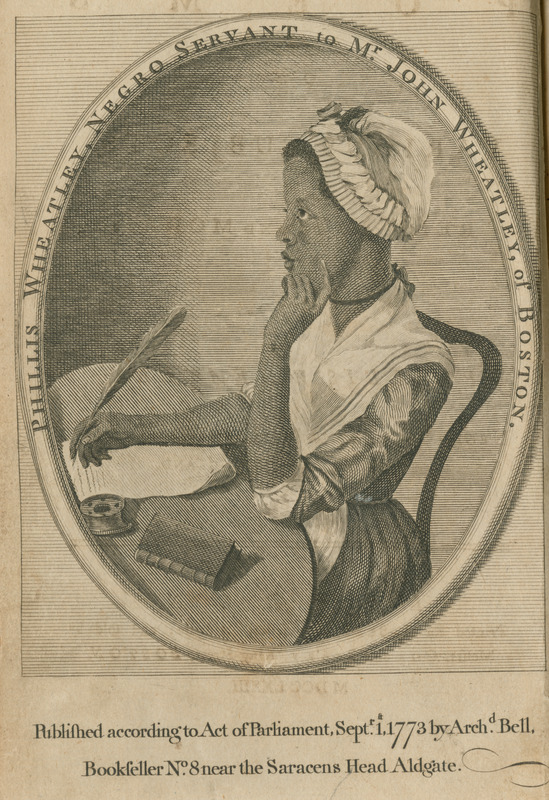
  • Three-quarter length portrait of Phillis Wheatley, seated at a table, with pen in hand; inkwell and book nearby.
    Still image

    Wheatley, Phillis, 1753-1784

    Three-quarter length portrait of Phillis Wheatley, seated at a table, with pen in hand; inkwell and book nearby.
  • A photographic reproduction of a drawing by Johannes Woudanus of the library at Leiden University, showing the organization of materials by topic.
    Still image

    Reproduction of a drawing of the library of Leiden University in 1600 by Johannes Woudanus

    Jonker, Hendrik, 1883-1944
    A photographic reproduction of a drawing by Johannes Woudanus of the library at Leiden University, showing the organization of materials by topic.
  • An account of the mission work of John Marrant amongst the Cherokee.
    Text

    A narrative of the Lord's wonderful dealings with John Marrant, a black, (now going to preach the gospel in Nova-Scotia) born in New-York, in North-America

    Marrant, John, 1755-1791
    An account of the mission work of John Marrant amongst the Cherokee.
  • Portrait of Jacobus Elisa Johannes Capitein, the first black minister who was educated in the Netherlands, with his hand on the Bible. He was a minister at Fort Elmina, in his homeland, present-day Ghana. Below the portrait is a ten-line verse.
    Still image

    Portret van predikant Jacobus Elisa Johannes Capitein

    Tanjé, Pieter, 1706-1761
    Portrait of Jacobus Elisa Johannes Capitein, the first black minister who was educated in the Netherlands, with his hand on the Bible. He was a minister at Fort Elmina, in his homeland, present-day Ghana. Below the portrait is a ten-line verse.
  • A work on the process of reduction and inductive reasoning, the precursor of the scientific method.
    Text

    Franc. Baconis de Verulamio, summi Angliæ cancelsarij, Novum organum scientiarum

    Bacon, Francis, 1561-1626
    A work on the process of reduction and inductive reasoning, the precursor of the scientific method.
  • A journal, devoted to the interests of Southern agriculture; designed to improve the mind, and elevate the character of the tillers of the soil, and to introduce a more enlightened system of culture.
    Text

    Southern cultivator

    A journal, devoted to the interests of Southern agriculture; designed to improve the mind, and elevate the character of the tillers of the soil, and to introduce a more enlightened system of culture.
  • The journal of William Dunbar from 1804-1805. He was a southern Mississippi planter. The journal casts light on and details relations of power including performances between plantation slavers and enslaved. It shows how both parties lived and at least provokes imaginings about sentiments.
    Text

    William Dunbar Journal

    Dunbar, William, 1749-1810
    The journal of William Dunbar from 1804-1805. He was a southern Mississippi planter. The journal casts light on and details relations of power including performances between plantation slavers and enslaved. It shows how both parties lived and at least provokes imaginings about sentiments.
  • Seated to right, seen on profile, Flavio Amalfitano at his desk measuring a compass while reading a book; a globe and an hourglass also seen on his desk and a dog at his feet; opposite him, floating on air, a sailing ship and below another desk with books and an astrolabe globe; a large recipient filled with liquid and a stone at entre seen in the foreground, to left.
    Still image

    Lapis Polaris Magnes

    Straet, Jan van der, 1523-1605
    Seated to right, seen on profile, Flavio Amalfitano at his desk measuring a compass while reading a book; a globe and an hourglass also seen on his desk and a dog at his feet; opposite him, floating on air, a sailing ship and below another desk with books and an astrolabe globe; a large recipient filled with liquid and a stone at entre seen in the foreground, to left.
  • A description of the customs of indigenous peoples of the Americas as recorded by colonizing forces.
    Text

    Mœurs des sauvages ameriquains, comparées aux mœurs des premiers temps

    Lafitau, Joseph-François, 1681-1746
    A description of the customs of indigenous peoples of the Americas as recorded by colonizing forces.
  • A photocopy of a translation of a section of Beowulf by Seamus Heaney.
    Text

    Beowulf, photocopied holograph draft of translation

    Heaney, Seamus, 1939-2013
    A photocopy of a translation of a section of Beowulf by Seamus Heaney.
  • A poster reproduction of a painting by David Teniers the Younger depicting the temptation of the desert father St. Anthony by demons.
    Still image

    La Tentation de Saint Antoine

    A poster reproduction of a painting by David Teniers the Younger depicting the temptation of the desert father St. Anthony by demons.
  • An engraving of Daniel, flanked by a lion and lioness, the four beasts from his vision depicted in the sky on either side of his head.
    Still image

    Effigies Danielis

    Ganière, Pierre, 1663-1721
    An engraving of Daniel, flanked by a lion and lioness, the four beasts from his vision depicted in the sky on either side of his head.
  • An engraving of the four beasts which appeared to Daniel in a vision rising from the sea.
    Still image

    The Vision of the Four Beasts

    Doré, Gustave, 1832-1883
    An engraving of the four beasts which appeared to Daniel in a vision rising from the sea.
  • An engraving of Dante and Virgil facing off against a horde of demonic entities as they travel through Hell.
    Still image

    Be none of you outrageous

    Doré, Gustave, 1832-1883
    An engraving of Dante and Virgil facing off against a horde of demonic entities as they travel through Hell.
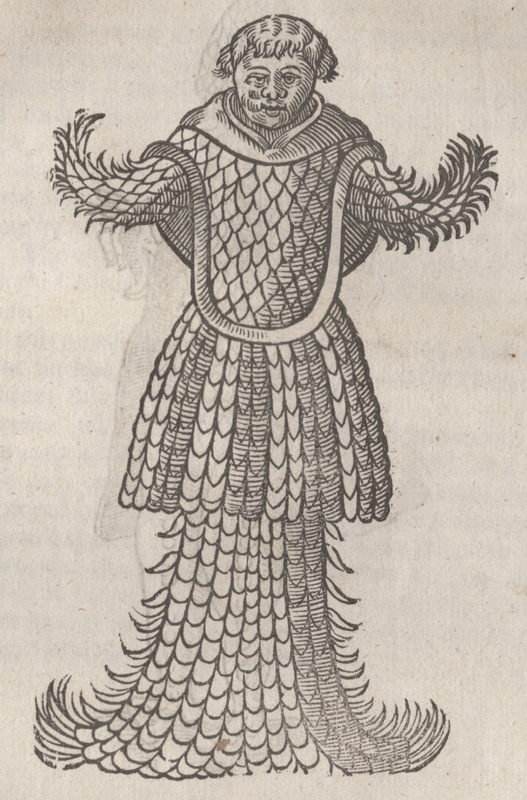
  • A woodcut depicting a monstrous fish purportedly pulled from the sea in Poland, which had the appearance of a Catholic monk.
    Still image

    Monk Fish

    A woodcut depicting a monstrous fish purportedly pulled from the sea in Poland, which had the appearance of a Catholic monk.
  • A woodcut depicting a monstrous fish purportedly pulled from the sea in Poland, which had the appearance of a Roman Catholic bishop.
    Still image

    Bishop Fish

    A woodcut depicting a monstrous fish purportedly pulled from the sea in Poland, which had the appearance of a Roman Catholic bishop.
  • A woodcut depicting the four beasts described in Daniel's vision placed on a map, one each in Europe and Africa, and two in Asia. The beasts are placed in such a way that they surround the holy land.
    Still image

    Map of the Four Beasts from Daniel's Vision

    A woodcut depicting the four beasts described in Daniel's vision placed on a map, one each in Europe and Africa, and two in Asia. The beasts are placed in such a way that they surround the holy land.
  • An engraving of the two beasts mentioned in Revelations. On the left, is the seven-headed beast from the sea. On the hill to the right is the "lamb-horned" beast from the earth.
    Still image

    The Beasts from the Sea and Earth

    An engraving of the two beasts mentioned in Revelations. On the left, is the seven-headed beast from the sea. On the hill to the right is the "lamb-horned" beast from the earth.
  • An engraving of the four beasts which appeared to Daniel in a vision. Each beast represented a different kingdom and is labeled from left to right: Roma (Rome), Grecia (Greece), Persia, and Asyria.
    Still image

    Daniel's Vision of the Four Beasts

    An engraving of the four beasts which appeared to Daniel in a vision. Each beast represented a different kingdom and is labeled from left to right: Roma (Rome), Grecia (Greece), Persia, and Asyria.
  • An engraving of the dragon mentioned in Revelations, which granted power and authority to the Beast from the Sea and the Beast from the Earth.
    Still image

    Vision que Saint Iean eut du Dragon

    Le Clerc, Sébastien, 1637-1714
    An engraving of the dragon mentioned in Revelations, which granted power and authority to the Beast from the Sea and the Beast from the Earth.
  • An engraving of Daniel sleeping (left) as his vision of the four beasts (right) appear, each beast labeled with the kingdom they represent: Roma (Rome), Grecia (Greece), Persia, and Assyria.
    Still image

    Visions de Daniel touchant les quatre Monarchies, des Assyriens, des Perses, des Grecs, & des Romains

    Le Clerc, Sébastien, 1637-1714
    An engraving of Daniel sleeping (left) as his vision of the four beasts (right) appear, each beast labeled with the kingdom they represent: Roma (Rome), Grecia (Greece), Persia, and Assyria.
  • A woodcut depicting two boys, one born with four [feet] and one born without hands or eyes and the lower body of a fish. These beings are described in the text as being portents of the coming of Islam, implying that Islam was a danger to Christians.
    Still image

    Monstrous Portents of Islam

    A woodcut depicting two boys, one born with four [feet] and one born without hands or eyes and the lower body of a fish. These beings are described in the text as being portents of the coming of Islam, implying that Islam was a danger to Christians.
  • A woodcut of the first Beast mentioned in Revelations, which emerged from the sea. It has seven heads and ten horns.
    Still image

    The Beast from the Sea

    A woodcut of the first Beast mentioned in Revelations, which emerged from the sea. It has seven heads and ten horns.
  • A woodcut of the two beasts mentioned in Revelations. On the right, is the seven-headed beast from the sea. On the hill in the background is the "lamb-horned" beast from the earth.
    Still image

    The Beasts from the Sea and Earth

    A woodcut of the two beasts mentioned in Revelations. On the right, is the seven-headed beast from the sea. On the hill in the background is the "lamb-horned" beast from the earth.
  • A woodcut depicting a hairy, bipedal beast, labeled as the "spook of the evil ghost," which is found in a vast desert beyond India in the land of Cathay. This type of ghost is said to lead travellers astray by mimicking the voices of their travelling companions.
    Still image

    Gespängst der bösen geist

    A woodcut depicting a hairy, bipedal beast, labeled as the "spook of the evil ghost," which is found in a vast desert beyond India in the land of Cathay. This type of ghost is said to lead travellers astray by mimicking the voices of their travelling companions.
  • A woodcut of the four beasts which appeared to Daniel in a vision. Each beast represented a different kingdom.
    Still image

    Daniel's Vision of the Four Beasts

    A woodcut of the four beasts which appeared to Daniel in a vision. Each beast represented a different kingdom.
  • A woodcut depicting Martin Luther as a seven-headed monster, critiquing his deviation from Catholicism. Each head is labeled (from left to right): Doctor, Martinus, Luther, Ecclesiast, Schwirmer [Schwärmer], Visitieter, and Barrabas. This was a classic piece of Catholic propaganda, portraying Luther not only as a Doctor and Churchman, but as a Turk, a wild enthusiast (Schwarmer) and "Barrabas."
    Still image

    Sieben Köpffe Martini Luthers vom hochwirdigen Sacrament des Altars

    A woodcut depicting Martin Luther as a seven-headed monster, critiquing his deviation from Catholicism. Each head is labeled (from left to right): Doctor, Martinus, Luther, Ecclesiast, Schwirmer [Schwärmer], Visitieter, and Barrabas. This was a classic piece of Catholic propaganda, portraying Luther not only as a Doctor and Churchman, but as a Turk, a wild enthusiast (Schwarmer) and "Barrabas."
  • A woodcut depicting the Monk-Calf of Freyberg, which was born with a tonsure-like irregularity on its head, resembling the common hairstyle of a Catholic monk.
    Still image

    Das Munchkalb zu Freyberg

    A woodcut depicting the Monk-Calf of Freyberg, which was born with a tonsure-like irregularity on its head, resembling the common hairstyle of a Catholic monk.
  • A woodcut depicting the "Papal Ass," a monster purported to have been pulled from the Tiber in Rome as a portent of the corruption of the Roman Catholic Church.
    Still image

    Der Bapstesel zu Rom

    A woodcut depicting the "Papal Ass," a monster purported to have been pulled from the Tiber in Rome as a portent of the corruption of the Roman Catholic Church.
  • Summary: A metrical Latin version of a traditional didactic Christian text in the form of a bestiary.
    Text

    Physiologus : a metrical bestiary of twelve chapters

    Theobaldus, Episcopus
    Summary: A metrical Latin version of a traditional didactic Christian text in the form of a bestiary.
  • Summary: An Irish translation of the Historia Brittonum ("The History of the Britons"), including the purported classical origin of the people as well as the legends surrounding King Arthur.
    Text

    Irish version of the Historia Britonum of Nennius

    Summary: An Irish translation of the Historia Brittonum ("The History of the Britons"), including the purported classical origin of the people as well as the legends surrounding King Arthur.
  • Summary: A novel conveying the fictional tale of a young woman falsely accused of witchcraft.
    Text

    Mary Schweidler, the amber witch. : The most interesting trial for witchcraft ever known, printed from an imperfect manuscript by her father, Abraham Schweidler, the pastor of Coserow, in the island of Usedom

    Meinhold, Wilhelm, 1797-1851
    Summary: A novel conveying the fictional tale of a young woman falsely accused of witchcraft.
  • Summary: A collection of the works of Washington Irving.
    Text

    The complete works of Washington Irving in one volume : with a memoir of the author.

    Irving, Washington, 1783-1859
    Summary: A collection of the works of Washington Irving.
  • Summary: A historical, social, religious, and natural history of the ancient world.
    Text

    Caii Julii Solini, grammatici, Polyhistor : ab ipso editus et recognitus

    Solinus, C. Julius, active 3rd century
    Summary: A historical, social, religious, and natural history of the ancient world.
  • Summary: A collection of the works of Saint Isidore, of Seville.
    Text

    S. Isidori hispalensis episcopi ... opera omnia

    Isidore, of Seville, Saint, -636
    Summary: A collection of the works of Saint Isidore, of Seville.
  • Summary: A repudiation of the understanding of "prodigies," monstrous births in humans or animals, as signs from God.
    Text

    A discourse concerning prodigie : wherein the vanity of presages by them is reprehended, and their true and proper ends asserted and vindicated

    Spencer, John, 1630-1693
    Summary: A repudiation of the understanding of "prodigies," monstrous births in humans or animals, as signs from God.
  • Summary: A philosophical work discussing issues of faith versus unbelief through the symbolism of two societies, "The City of God" and "The City of Man".
    Text

    Saint Augustine, Of the citie of God : with the learned comments of Io. Lodovicus Vives ...

    Augustine, of Hippo, Saint, 354-430
    Summary: A philosophical work discussing issues of faith versus unbelief through the symbolism of two societies, "The City of God" and "The City of Man".
  • Summary: The sermons on which this commentary on the Ten Commandments is based were delivered in Wittenberg in 1516-1517. This is the first work of Luther's to be translated into a modern European language. This is the first printing of the work.
    Text

    Decem praecepta Witte[n]berge[n]si praedicata populo

    Luther, Martin, 1483-1546
    Summary: The sermons on which this commentary on the Ten Commandments is based were delivered in Wittenberg in 1516-1517. This is the first work of Luther's to be translated into a modern European language. This is the first printing of the work.
  • Original records of seventy-nine trials at the Inquisition in Barcelona, Spain signed by the inquisitors. The text contains their declarations, confessions and the testimonies of witnesses. Crimes include pacts with the devil, sorcery, witchcraft, sodomy, traffic with ghosts, etc.
    Text

    Tribunal of the Inquisition at Barcelona records

    Inquisidor General de España
    Original records of seventy-nine trials at the Inquisition in Barcelona, Spain signed by the inquisitors. The text contains their declarations, confessions and the testimonies of witnesses. Crimes include pacts with the devil, sorcery, witchcraft, sodomy, traffic with ghosts, etc.
Page 1 of 1
Close