Search
-
![Map of Jerusalem taken from Sebastian Münster's Cosmographia (Basel: Heinrich Petri, 1544), YY4-5 (pages [1015]-1018).](https://s3.us-west-2.amazonaws.com/omekacloud-main/large/P_MSS400_B001_F003_I001/P_MSS400_B001_F003_I001_P001_PROD.jpg) Still image
Still imageIerusalem ciuitas sancta, olim metropolis regni Iudaici, hodie uero colonia Turcae
Map of Jerusalem taken from Sebastian Münster's Cosmographia (Basel: Heinrich Petri, 1544), YY4-5 (pages [1015]-1018). -
 Still image
The Scourging of Christ
Schäufelein, Hans, approximately 1480-approximately 1539A colorized woodcut by Hans Schäufelein taken from a 16th century devotional work, "Speculum passionis Domini Nostri Ihesu Christi," by the Nuremberg doctor and publisher Ulrich Pinder (1507 PIND), which depicts the scourging of Christ. -
 Text
TextDas Newe Testament Deůtzsch
Summary: Luther's translation from the original Greek of the New Testament is a landmark in the history of the German language. His forceful style ensured that his Thuringian-Saxon dialect would provide the standard for High German in years to come. From a religious standpoint, Luther's decision to refer to the original Greek rather than merely to translate the Vulgate ensured that the German New Testament would be much more faithful to the original. Erasmus' New Testament provided the basis for the translation. -
 Text
TextEusebium Pamphili De euangelica praeparatione latinum ex graeco beatissime pater iussu tuo effeci...
Eusebius, of Caesarea, Bishop of Caesarea, approximately 260-approximately 340Summary: -
![An engraving of a medallion or coin featuring James II of England on the face, framed by the inscription "IACOBUS II DEI GRA ANG SCOT FRAN ET HIB REX" ("James II, by the grace of God, King of England, Scotland, [France?], and [Hibernia]"). On the back, there is a scene of a naval battle behind a set of Roman style armaments beneath the inscription "GENUS ANTIQUUM".](https://s3.us-west-2.amazonaws.com/omekacloud-main/large/P_300000272988_P015/P_300000272988_P015.jpg) Still image
Still imageEngraving of a medallion or coin featuring James II on the face
An engraving of a medallion or coin featuring James II of England on the face, framed by the inscription "IACOBUS II DEI GRA ANG SCOT FRAN ET HIB REX" ("James II, by the grace of God, King of England, Scotland, [France?], and [Hibernia]"). On the back, there is a scene of a naval battle behind a set of Roman style armaments beneath the inscription "GENUS ANTIQUUM". -
-
 Text
TextKhristajayantīcī bheṭa : "deva prīti āhe."
Tilak, Narayan Vaman, 1862?-1919Summary: Poem on the birth of Jesus Christ. -
 Text
TextJohn Wesley's place in church history : determined with the aid of facts and documents unknown to, or unnoticed by, his biographers
Urlin, R. Denny (Richard Denny), 1830-1907Summary: A biography of John Wesley, placing him within the wider church history. -
 Text
TextMemorials of the life of Peter Böhler : Bishop of the Church of the United Brethren
Lockwood, John PriorSummary: A collection of memorials in honor of Peter Böhler, a bishop of the Church of the United Brethren. -

-
 Text
TextNotes of a journey through Durham and Northumberland in the year 1635
Brereton, William, 1604-1661Summary: A travelogue detailing the areas of Durham and Northumberland. -
 Text
TextDeaconesses : Who they are, and what they do
Meyer, Lucy Rider, 1849-1922Summary: An overview of the role, responsibilities, and work of deaconesses. -
 Text
TextA funeral sermon occasioned by the death of that eminent servant of God, the Rev. John Wesley, who departed this life March 2, 1791, in the 88 year of his age. : preached in the Methodist Chapel at Hull, March 10, 1791
Taylor, Thomas, 1738-1816Summary: A funeral sermon delivered by Taylor Thomas in honor of John Wesley. -
 Text
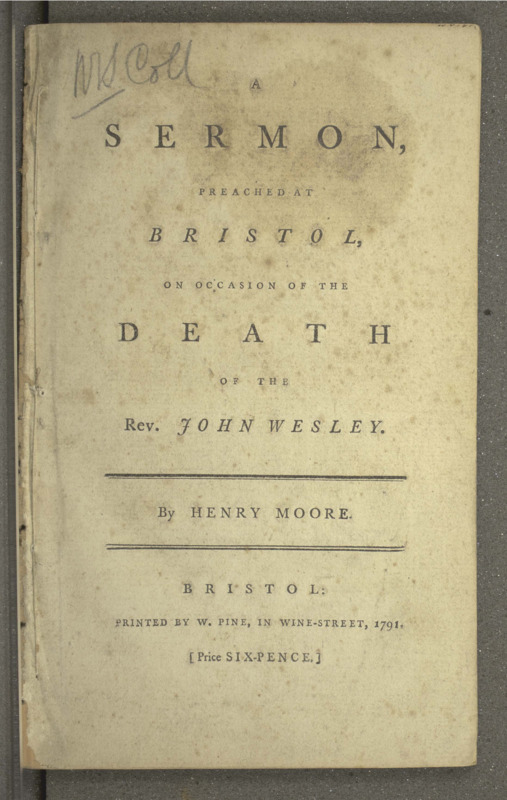
TextA sermon, preached at Bristol, on occasion of the death of the Rev. John Wesley
Moore, Henry, 1751-1844Summary: A sermon delivered by Henry Moore in honor of John Wesley. -
 Text
TextA sermon, on the death of the Rev. J. Wesley ... : delivered at the New Chapel, in Edmund Street, Liverpool, Sunday, March 27th, 1791
Hobrow, WSummary: A sermon delivered by W. Hobrow in honor of John Wesley. -
 Text
TextThe proceedings and tryal in the case of the Most Reverend Father in God William Lord Archbishop of Canterbury, and the Right Reverend Fathers in God, William Lord Bishop of St. Asaph, Francis Lord Bishop of Ely, John Lord Bishop of Chichester, Thomas Lord Bishop of Bath and Wells, Thomas Lord Bishop of Peterborough, and Jonathan Lord Bishop of Bristol : in the Court of the Kings-bench at Westminster, in Trinity-term in the fourth year of the reign of King James the Second, annoque Dom. 1688.
Sancroft, William, 1617-1693Summary: Proceedings against William Sancroft, Archbishop of Canterbury, and six other bishops for publishing seditious libel against James II. -
 Text
TextThe Prince of Orange his declaration: shewing the reasons why he invades England. : With a short preface, and some modest remarks on it.
William III, King of England, 1650-1702Summary: "The declaration of His Highnes William Henry, by the grace of God, Prince of Orange, &c. of the reasons inducing him, to appear in armes in the kingdome of England, for preserving of the Protestant religion, and for restoring the lawes and liberties of England, Scotland and Ireland": p. 4-14. "His Highnesses additional declaration": p. 16-17. "Animadversions upon the Declaration of His Highness the Prince of Orange": p. 19-32. -
 Text
TextParadise lost : a poem in twelve books
Milton, John, 1608-1674Summary: An epic poem retelling the biblical story of the temptation of Adam and Eve by Satan and their subsequent expulsion from the Garden of Eden. -
 Text
TextPrince George's letter to the King.
George, Prince, consort of Anne, Queen of Great Britain, 1653-1708Summary: A letter from Prince George to James II renouncing support for the King on religious grounds. -
 Text
TextHis Majesties gracious declaration to all his loving subjects for liberty of conscience
James II, King of England, 1633-1701Summary: An announcement by James II on the topic of freedom of religion in England. -
 Text
TextA short discourse concerning the reading His Majesties late declaration in the churches
Croft, Herbert, 1603-1691Summary: A justification for reading James II's declaration of indulgence in spite of the Archbishop of Canterbury's objections.

Page 203 of 254
