Search
-
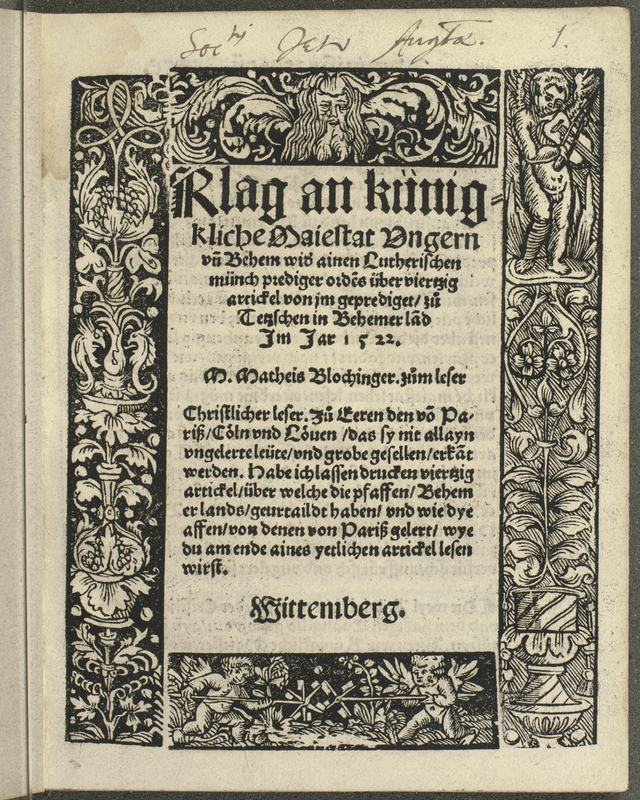 Still image
Historiated title page border of Matthias Blochinger's response to Dominicus Beyer's preaching
A woodcut border to Mattias Blochinger's response to Dominicus Beyer's preaching. The border consists of four separate woodcuts depicting a pair of cherubs dueling (bottom), decorative plant motif (left), a Wild Man or a Green Man (top), and a cherub playing either a violin or viola (right). -
 Still image
Initial letter with Moses delivering his farewell
Lemberger, Georg, 1495?-1540?A woodcut initial letter "D" illustrated with the scene of Moses delivering his farewell discourse while God looks down from Heaven. Moses is depicted with horns, a common practice in Western art before the Renaissance. -
 Still image
Initial letter with Moses kneeling before God
Lemberger, Georg, 1495?-1540?A woodcut initial letter "U" depicting Moses praying before God in Heaven, who is holding a globus cruciger. Moses is here depicted with horns, which was common before the Renaissance. The shape of the "U" includes two cherubs atop pillars and a bound bird. -
 Still image
Initial letter with a sheep on an altar
Lemberger, Georg, 1495?-1540?A woodcut initial letter "U" depicting a woman and a man kneeling before an altar with a sheep on it. The bottom and right curve of the "U" is made from the image of a dragon. -
 Still image
Priestly Garments
Cranach, Lucas, 1472-1553A woodcut depicting a preist dressed in the vestments described in Exodus 28, including an elaborate ephod and/or breastpiece, a long robe decorated with pomegranates and bells, and a decorated turban. -
 Still image
Tabernacle Court Layout
Cranach, Lucas, 1472-1553A woodcut depicting the full layout of the Tabernacle court, including the altar of burnt offerings, the bronze laver, and the inner tent with the table, lampstand, altar of incense, and the Ark of the Covanent. -
 Still image
Tabernacle's Inner Curtain
Cranach, Lucas, 1472-1553A woodcut depicting one of the inner curtains of the Tabernacle, decorated with cherubim in blue, purple, and scarlet yarn and displayed in the Tabernacle courtyard. -
 Still image
Tabernacle Frame
Cranach, Lucas, 1472-1553A woodcut depicting the acacia wood frames with silver bases for the tabernacle. -
 Still image
Lampstand and Table with Bread of Presence
Cranach, Lucas, 1472-1553A woodcut depicting the lampstand, table, and bread of presence surrounded by plates, jugs, and bowls. -
 Still image
Ark of the Covenant and Altar of Incense
Cranach, Lucas, 1472-1553A woodcut depicting the Ark of the Covanent with its lid decorated with two cherubim, and the Altar of Incense with a chalice of burning incense placed on it. -
 Still image
Altar of Burnt Offerings and Bronze Laver
Cranach, Lucas, 1472-1553A woodcut depicting the bronze laver for priestly washing (top), the altar of burnt offering made of acacia wood with four horns on its four corners (center), and the bronze implements for tending the altar (bottom). -
 Still image
Initial letter with the transfigured Christ
Lemberger, Georg, 1495?-1540?A woodcut initial letter "D" depicting Jesus Christ transfigured in the presence of Peter, James, and John. -
 Still image
Joseph interprets Pharaoh's Dream
Cranach, Lucas, 1472-1553A woodcut depicting Joseph beside Pharaoh's bedside (top) explaining the meaning of his dream of seven fat and seven lean cows, and seven good and seven lean stalks, represents seven years of feast and famine that will come to Egypt. -
 Still image
Jacob's Dream
Cranach, Lucas, 1472-1553A woodcut depicting God blessing Jacob as he dreams, represented by three angels descending/ascending a ladder linking Heaven and Earth. Above the woodcut is a section of handwritten marginalia. -
 Still image
Sacrifice of Isaac
Cranach, Lucas, 1472-1553A woodcut depicting Abraham preparing to sacrifice his son, Isaac, as a show of faith to God and being stopped by an angel, who provides a ram (center left) for sacrifice in Isaac's place. -
 Still image
Noah's Ark surviving the flood
Cranach, Lucas, 1472-1553A woodcut depicting Noah's Ark (Der Kaste Noe) safe and afloat amidst the torential rains (center). At the bottom of the image there is a field of fallen trees and dead people and animals left behind by the receeding waters. in the top left of the image there is a dove carrying an olive branch, signalling the receeding of the waters. -
 Still image
Initial letter with God creating the world
Lemberger, Georg, 1495?-1540?A woodcut initial letter "A" depicting God creating the world. the arch of the "A" is made from a bent over plam tree. -
 Still image
Printer's Device of Melchior Lotter
A woodcut printer's device of Melchior Lotter featuring a crest depicting the Brazen Serpent wrapped around a cross. -
 Still image
Initial letter with Moses delivering his farewell
Lemberger, Georg, 1495?-1540?A woodcut initial letter "D" illustrated with the scene of Moses delivering his farewell discourse while God looks down from Heaven. Moses is depicted with horns, a common practice in Western art before the Renaissance. -
 Still image
Historiated title page border of Luther's German translation of the Old Testament
Lemberger, Georg, 1495?-1540?A woodcut border to Luther's German translation of the Old Testament printed in 1523. The border is composed of one woodcut depicting an architectural arch supported by four columns, a gathering of cherubs (top and sides), and a group of worshipers (?) around a crucified Christ (bottom). -
 Still image
Printer's Device of Martin Landsberg
A woodcut depicting the printer's device of Martin Landsberg. The mark consists of two shields, one with what could be a stylized ox or cow head and a star (left) and the second with a city by a river (right). Per Davies in "Devices of the Early Printers, Vol. 9, pg. 196, "The town represented is on mounds in the former; here water seems to be indicated. If the allusion was originally to "Land" and "Berg", it is therefore now lost."

Page 191 of 254
